When I was small, my parents would set out from our village, Pakyim, carrying vegetables and goods to sell in Gangtok. The horses could manage the distance from Pakyim down to a place called Deorali without much trouble. But from Deorali, the final stretch up into the Gangtok bazar was a different kind of terrain — short, but steep, and close enough to the town itself that it made more sense to leave the horses behind and finish the climb on foot. Even today, that same stretch is only a twenty- or thirty-minute walk uphill, or about five minutes by car in clear traffic. It’s a short distance by any measure. But it was the specific point in the journey where everything changed — from riding to walking, from carrying the full route to only the final push into town.
So that’s what they did. They’d leave the horses at Deorali to rest for the day, walk the rest of the way up into the Gangtok bazar to sell whatever they’d brought, and in the evening, once the selling was done, walk back down to Deorali, climb onto the horses again, and ride the rest of the way home to Pakyim.
I didn’t think much of it as a child. Deorali was just the place where the horses waited — a practical stop on a trip that was my parents’ business, not mine. It’s only looking back on it now, as an adult building something of my own with my wife, Papita, that I understand what that stop actually was. It wasn’t a delay in the journey. It was the exact point where a full day’s route got set down, so the last and steepest part of it could be done lighter, on foot, without hauling everything the entire way.
What a deuraly actually is
A deuraly, generally, is a specific kind of place in the geography of the Himalaya: it sits on top of a hill or a mountain, beside a stream of water, at the point where a trail crosses from one side of the high ground to the other. It’s there for a reason. Travelers reach it tired, having climbed most of the way up, and it gives them somewhere to actually stop — to rest, to quench their thirst at the stream running beside it, to engage with other travelers making the same crossing, and to re-energize before whatever’s still ahead of them on the far side.
That last part matters more than it might seem at first. A deuraly was never just a private place to catch your breath alone. It was a shared one — the kind of spot where people going the same general direction, or coming from it, would naturally end up at the same time, exchange a few words, and then carry on. Rest and community showed up together, not as two separate things.
I want to be clear that this isn’t just a poetic word I picked because it sounded evocative for a brand name. Deorali, the specific place my family’s memory comes from, is real and findable — a ridge just below Gangtok, in Sikkim, that grew up around exactly that resting-place function over a long period of time. As Gangtok itself has expanded, Deorali has effectively become part of the city — but people still refer to it distinctly, the way a long-established neighborhood keeps its own identity even after being absorbed into a larger municipality, much like a suburb. It’s known today as a real southern commercial hub of Gangtok, home to the Do-drul Chorten, a stupa built in the middle of the last century, the Namgyal Institute of Tibetology, a respected center for the study of Tibetan and Buddhist history and culture, and an orchid sanctuary that preserves some of the native flowers found in that part of the eastern Himalaya. People have been stopping there, resting there, and quietly building meaning into that stop for a very long time — longer than my parents’ trips to the bazar, and certainly longer than me.
Why I named this after a real place, not an abstraction
That’s the reason I chose this name instead of something more abstract — a mood word, a wellness-industry phrase, something invented to sound calming without actually meaning anything specific. I wanted the name to carry an actual place and an actual family memory, not just an aesthetic I was hoping to evoke for its own sake. My parents stopped at Deorali not because the whole distance from Pakyim was too much to manage, but because the last stretch into Gangtok was a walk, not a ride, and Deorali was the natural point to make that switch — to set a load down, however briefly, before finishing the climb on foot.
We’re all traveling some version of a longer journey — the one our own mission calls, simply, the journey of life. Most of us rarely build in a real point along that journey where we set something down, quench our thirst, and talk to someone else making a similar climb, before the final push. We just carry the whole load the entire way, telling ourselves we’ll rest once we get there, once the current project wraps up, once the inbox is finally empty. But my parents’ stop at Deorali wasn’t a delay in their trip. It’s what made the last and hardest part of it possible at all — lighter, on foot, without the full weight of the day still on their backs.
Where this is actually going
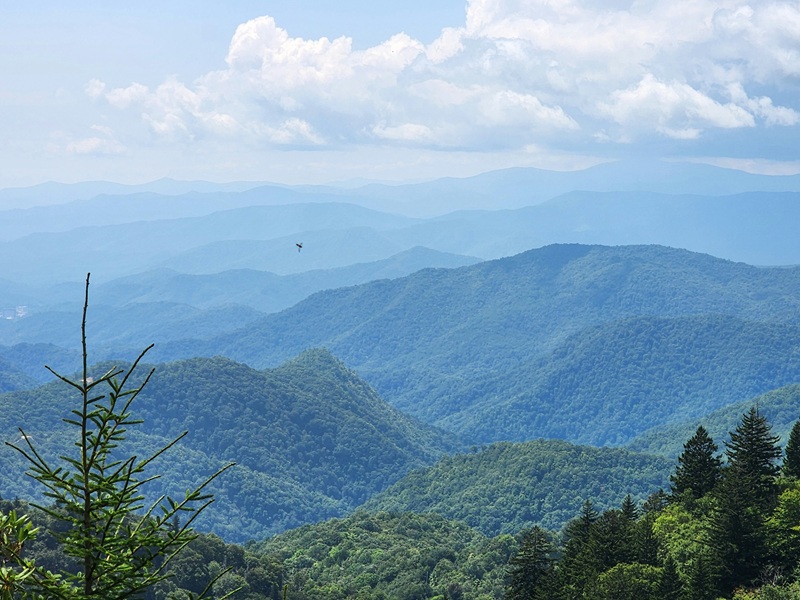
Papita and I both grew up in the hills of Sikkim and Darjeeling, spent twenty-plus years afterward in busy corporate careers that pulled us fairly far from that landscape, and are now making our way — slowly, and quite deliberately — toward a quieter life in the Appalachian hills of North Carolina, Tennessee, and Virginia. Different mountains entirely, but the same instinct underneath it: to disconnect from the grid for a while, reconnect with nature, and actually focus on our own wellbeing instead of treating it as something to get to eventually. We’re not there yet, and I want to be honest about that rather than dress it up as further along than it actually is. Right now, Deuraly is this: a journal of that journey, written from wherever we happen to be on the trail — the nature we notice along the way, the small mindfulness practices we’re relearning after years of not really prioritizing them, the activities that actually manage to get us off our screens instead of just promising to and then quietly failing.
But the reason we picked this specific name, and not something else, is tied to where we’re eventually headed: a small nature retreat of our own, somewhere in the Appalachians. Not a resort in the commercial sense, and not a branding exercise dressed up as a life plan. A place built on the same underlying idea Deorali itself was built on — that people on a long trip need a real point to pause, quench their thirst, meet a few fellow travelers, and gather themselves before the final and often steepest part of the climb. We think of it, quite literally, as building our own Deorali. A resting place for today’s travelers, the same way that real place, on that real trail, was one for my family.
Where we actually are right now
We’re not going to pretend the retreat is close, because it isn’t. Right now this is a laptop, a website we’re in the process of bringing back to life after a few dormant years, and a genuine commitment to write here regularly about the nature, mindfulness, and slow-living practices that are actually part of getting there — not the idealized version of that journey, but the real one, including the parts that are slower or messier than a polished brand story would usually admit.
If that’s a trip you’re on too — even just the modest, “screens down for one evening” version of it, rather than anything as dramatic as moving to the mountains — this is a good place to rest for a while, and to meet a few fellow travelers doing the same. If you’d like to follow the actual journey as it unfolds — the retreat search, the practices that end up working, the ones that quietly don’t — the best way is the newsletter. It’s the one place we’re not writing into an algorithm that decides who gets to see it.
Namaste, until we connect again.